
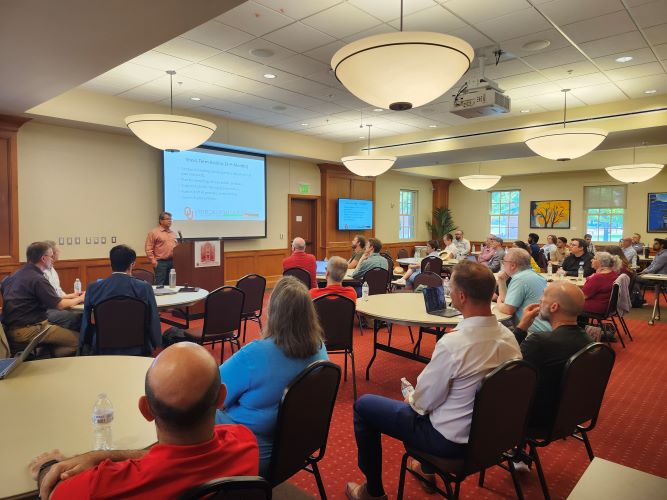
Norman, OK – June 10, 2025— As part of the University of Oklahoma’s growing AI Initiative, the AI Research Working Group—co-led by Dr. Andy Fagg, Brian E. and Sandra O’Brien Presidential Professor and Associate Professor of Computer Science, and Dr. Michael Wimberly, Interim Director of the Data Institute for Societal Challenges and Professor of Geography and Environmental Sustainability—hosted a vibrant Lunch and Learn event, drawing more than 50 attendees from across campus and disciplines. Held on June 10, the gathering showcased the breadth and depth of OU’s engagement with artificial intelligence, spanning philosophical inquiry, literary theory, cybersecurity, and environmental sustainability.
Moderated by Dr. Hunter Heyck, Professor in History of Science, the event featured a panel of experts who shared unique perspectives on how AI is reshaping their fields and society at large.
Dr. Michael Wimberly opened the session with an overview of the university’s AI efforts. He emphasized OU’s strategic role in leveraging AI for societal benefit—particularly through research collaborations and data-driven solutions. “OU is positioned to be a leader in cutting-edge research to address the opportunities as well as the challenges presented by the rise of AI,” he noted.
A highlight of the event was Dr. Mark Raymond, Wick Cary Associate Professor of International Security and Director of the Cyber Governance and Policy Center. Raymond examined the intersections of trust, governance, and AI, offering insights into how institutions can develop ethical and effective frameworks for managing rapidly evolving technologies.
Bringing a humanities lens to the conversation, Dr. Rebecca Huskey, Associate Professor of Classics and Letters, addressed the question:AI – What’s helpful, what’s hopeful, and what’s just hype?Her talk challenged attendees to think critically about public narratives surrounding AI and how to distinguish meaningful innovation from marketing buzz.
Dr. Julia Abramson, Associate Professor of French and Faculty Fellow in the Office of the Vice President for Research and Partnerships, reflected on the implications of generative AI for authorship in her presentation,What is an author now?She explored how concepts of creativity and originality are shifting in the age of machine-generated text.
The event also featured a compelling contribution from the next generation of AI scholars. Matthew Beasley, a graduate student in Philosophy, presentedFaux-Sentiment Artificial Intelligence: Epistemic Trespassing at Scale,a thought-provoking analysis of AI’s attempt to replicate human emotional expression and the philosophical concerns it raises.
“Campus-wide, interdisciplinary dialogues about AI and its implications are critical as OU positions itself to lead in this space,” said Dr. Andy Fagg. The AI Lunch and Learn is more than just a panel—it reflects OU’s deep commitment to fostering a diverse, intellectually rigorous AI research program. With events like this, the university continues to position itself at the forefront of AI innovation and ethical use.